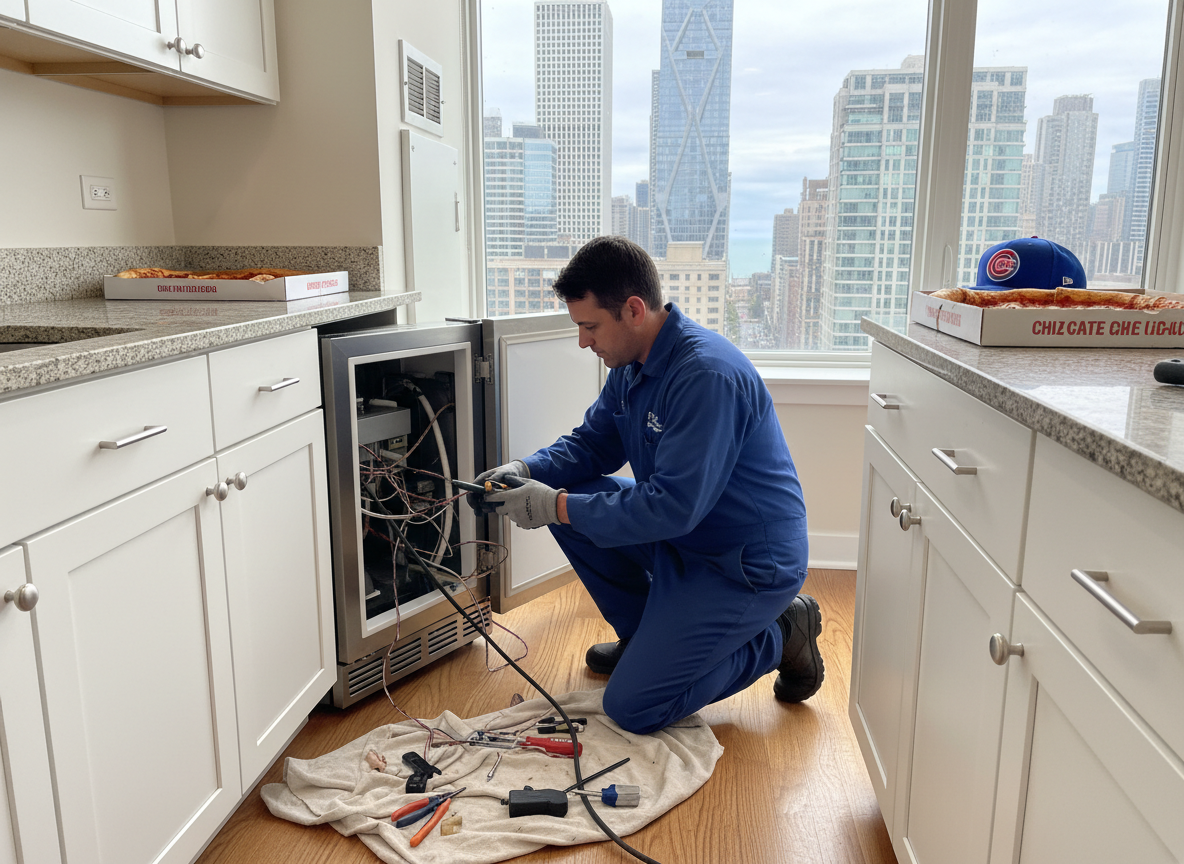
Chicago's humid continental climate brings cold winters that frequently freeze water supply lines feeding icemakers in older homes throughout Lincoln Park and Wicker Park. Many two-flats and greystones built before 1960 still use galvanized piping that narrows with age, restricting flow to the inlet valve and causing slow or hollow ice production. Technicians often find these lines running through uninsulated exterior walls near the Chicago Riverwalk area where temperatures drop sharply overnight.
Hard water common across Cook County leaves mineral scale inside the icemaker mold and solenoid valves, especially in Lakeview and Logan Square buildings served by older municipal lines. This buildup triggers incomplete cube release and cloudy ice that homeowners notice first in summer when demand rises. Replacement parts must match the exact model because many 1990s through 2010s refrigerators installed during renovations in Uptown and Andersonville use proprietary valves that fail after five to seven years of scale exposure.
Service calls in Bridgeport and Pilsen frequently involve refrigerators located in finished basements where floor drains and sump pumps sit close to the appliance. Any leak from a cracked fill tube can reach nearby electrical outlets before the homeowner notices. Techs carry longer tubing and shutoff valves rated for Chicago's water pressure to prevent repeat failures after the initial repair.
Technician insight
In Chicago the thing that catches most people out with icemaker repair is galvanized supply lines that have narrowed over decades in Wicker Park and Logan Square two-flats; the reduced flow looks like a bad valve until you pull the line and see the rust flakes.
Slow Ice Production In Lincoln Park Greystone
Homeowner in a 1920s Lincoln Park building reported cubes taking over six hours to form. Inspection showed the original galvanized line feeding the icemaker had restricted to half its diameter from mineral scale. The valve was still functional but starved for water. New copper tubing was run from the shutoff and a fresh inlet valve installed; ice production returned to normal within the next cycle.
Icemaker Repair Services We Offer
✓Water Inlet Valve Replacement
Swaps the solenoid valve that controls water flow into the icemaker, restoring consistent cube production in homes with hard Chicago tap water.
✓Frozen Water Line Thaw and Repair
Locates and thaws supply lines frozen during winter cold snaps common in West Loop and South Loop buildings, then adds insulation to prevent recurrence.
✓Icemaker Mold and Heater Repair
Replaces the mold tray and internal heater that release cubes, fixing incomplete harvest cycles often seen in older refrigerators throughout Hyde Park.
✓Fill Tube and Auger Replacement
Installs new fill tubing and auger motor components to stop leaks and restore ice dispensing in high-use kitchens near Navy Pier and Grant Park.
✓Control Module Diagnostics
Tests the electronic board that times ice production cycles, correcting erratic operation in units installed during renovations in Rogers Park and Evanston.
Icemaker Repair Cost in Chicago, IL
| Service | Typical Range | What Affects It |
|---|---|---|
| Diagnostic visit | $95–$150 | Waived if repair is approved same day |
| Inlet valve replacement | $180–$320 | Varies by refrigerator brand and access in older homes |
| Frozen line thaw plus insulation | $200–$375 | Higher in multi-story buildings with long runs |
| Full icemaker assembly swap | $250–$450 | Includes new mold, heater, and module when needed |
Ranges are typical for Chicago, IL and confirmed with an exact written quote before any work starts.
How it works
- 1
Initial Assessment
Technician inspects the refrigerator model, water supply line routing, and ice production symptoms on site in the customer's Chicago neighborhood.
- 2
Component Testing
Voltage checks on the inlet valve, heater, and control board identify the exact failure without unnecessary part swaps.
- 3
Repair Execution
Faulty parts are replaced using manufacturer-matched components while protecting surrounding cabinetry and flooring common in older Cook County homes.
- 4
System Verification
Full cycle test confirms proper cube formation, release, and dispensing before the technician leaves the property.
Pricing
Upfront quotes given after diagnostic; no work begins without homeowner approval.