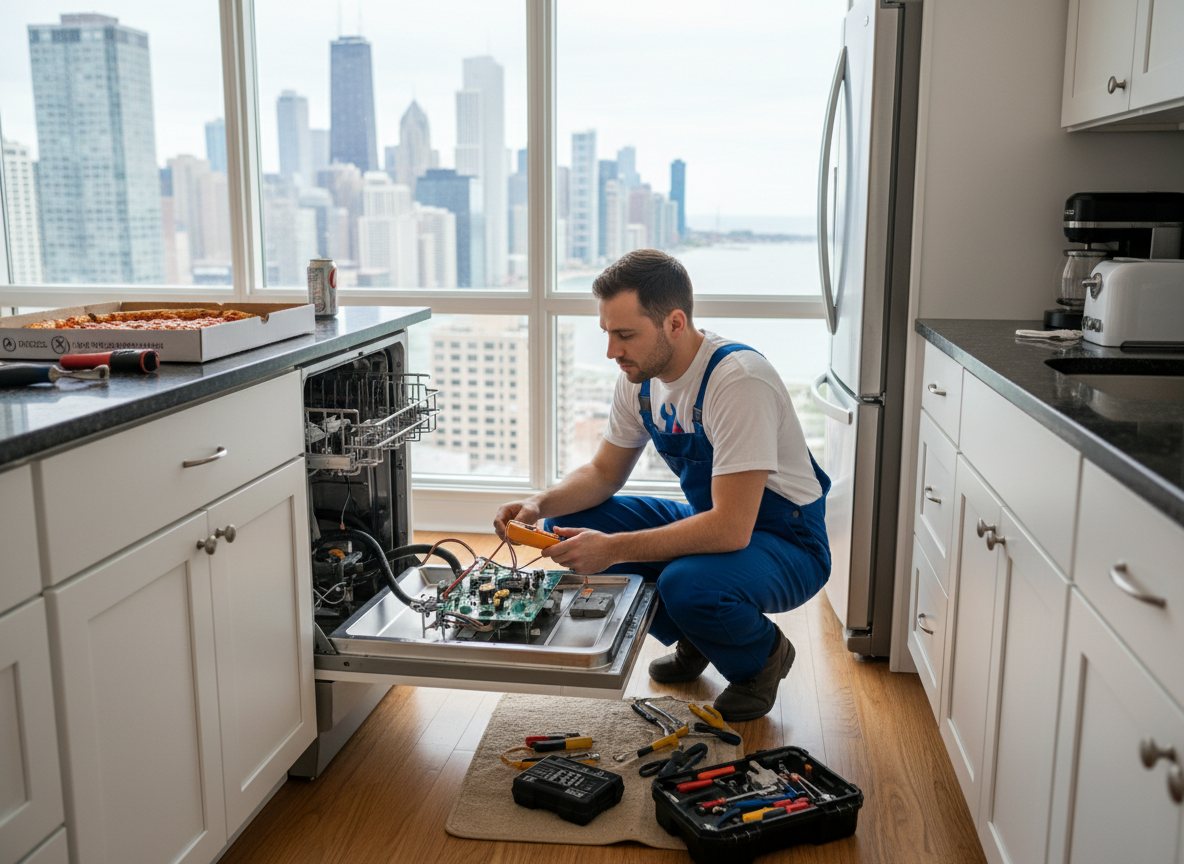
Chicago's older housing stock in neighborhoods like Bridgeport and Pilsen often features galvanized or cast-iron drain lines that trap food particles and grease, leading to repeated clogs in dishwasher outlets. Technicians must account for these narrow pipes and the sediment buildup common after decades of use. Humid summers increase condensation inside units, while winter temperature swings can cause supply-line contraction that loosens fittings. Service calls in these areas routinely include checking the air gap and testing the high-loop drain configuration required by local codes.
In Logan Square and West Loop buildings converted from industrial use, dishwashers are frequently installed on shared risers with limited access. This setup means a single failed check valve can affect multiple units and requires isolating the water supply without shutting down neighboring apartments. Technicians carry adapters for both 3/8-inch and 1/2-inch compression fittings common in these conversions. Hard water from Lake Michigan sources accelerates mineral scale on spray arms and heating elements, shortening component life compared with suburban installations.
Homes near the Chicago Riverwalk and in South Loop high-rises face vibration from nearby rail lines that can loosen internal dishwasher mounts over time. Technicians inspect the leveling feet and tub seals during every visit because even minor movement creates leaks that stain cabinetry. Service in these buildings also requires coordinating with building management for freight-elevator access and noise restrictions after 8 p.m.
Technician insight
In Chicago, the thing that catches most people out with Dishwasher Repair is the age of the drain lines in pre-1960 homes in neighborhoods like Pilsen and Bridgeport. Those old pipes narrow with grease and sediment, so even a new pump will fail again unless the line is cleared or rerouted during the visit.
Logan Square Conversion Unit Leak
A dishwasher in a converted factory building was leaking onto the floor during every cycle. Inspection showed the original galvanized drain line had corroded and the high loop had been removed during a prior remodel. The technician replaced the hose, restored the high-loop configuration, and cleared the shared riser connection. The unit now drains cleanly without affecting the unit below.
Dishwasher Repair Services We Offer
✓Drain Hose Replacement
Swap clogged or cracked drain hoses that fail in older Chicago plumbing. Proper high-loop installation prevents backflow in multi-unit buildings.
✓Door Seal Replacement
Install new gaskets to stop leaks common in humid summers when condensation builds inside units in Lincoln Park and Lakeview homes.
✓Pump Motor Replacement
Replace failing drain pumps that cannot handle grease-laden Chicago wastewater, restoring full drainage without repeated service calls.
✓Heating Element Repair
Fix or replace elements scaled by Lake Michigan minerals so dishes sanitize properly during cold winter cycles.
✓Control Board Diagnostics
Diagnose electronic boards affected by voltage fluctuations in older Cook County wiring and restore cycle selection functions.
✓Spray Arm Cleaning and Alignment
Clear mineral blockages and realign arms to ensure even water distribution in units installed on uneven floors common in Wicker Park conversions.
Dishwasher Repair Cost in Chicago, IL
| Service | Typical Range | What Affects It |
|---|---|---|
| Drain hose replacement | $180–$320 | Higher in multi-story buildings requiring extra access time |
| Door seal replacement | $150–$275 | Depends on model and whether custom gaskets are needed |
| Pump motor replacement | $250–$450 | Includes labor; parts vary by brand availability in Chicago |
| Heating element repair | $200–$380 | Scale removal adds time in hard-water areas |
Ranges are typical for Chicago, IL and confirmed with an exact written quote before any work starts.
How it works
- 1
Schedule And Arrival
Call 24/7 to book a same-day visit. The technician confirms the building access details for Chicago neighborhoods before arriving with common parts stocked for local models.
- 2
On-Site Diagnosis
The tech runs a full cycle, checks water pressure, tests the drain line, and inspects seals while noting any building-specific constraints like shared risers.
- 3
Repair And Testing
Parts are replaced or adjusted on the spot, the unit is leveled, and a final cycle confirms proper drainage and heating before departure.
- 4
Homeowner Walkthrough
The technician explains any maintenance steps suited to Chicago water conditions and leaves contact information for follow-up questions.
Pricing
Upfront quotes after inspection with no surprise charges.