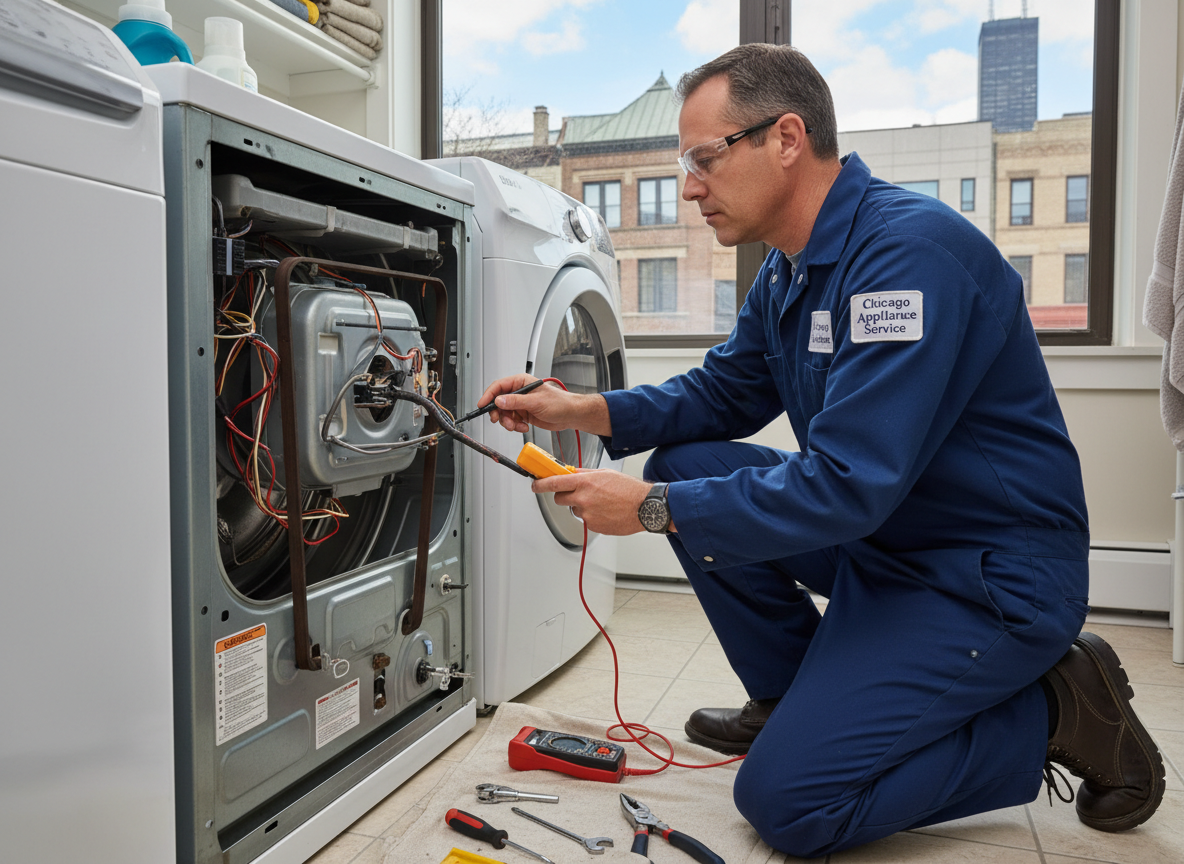
Chicago's humid continental climate brings cold winters that push homeowners to run dryers more often while older housing stock in neighborhoods like Wicker Park and Logan Square features narrow utility rooms and aging 3-inch or 4-inch vent runs that collect lint quickly. In multi-unit buildings common in the West Loop and South Loop, shared or poorly routed vents increase back-pressure and fire risk when lint blocks airflow. Technicians routinely find crushed flexible duct behind stacked washer-dryer units or vents terminating too close to ground level where snow and ice add resistance during January and February.
Electric dryers dominate single-family homes in Lincoln Park and Hyde Park while gas models appear more in Andersonville and Rogers Park. Both types suffer from failed heating elements or igniters after 8–12 years of heavy seasonal use. Technicians check for 240-volt supply issues at older breaker panels and inspect lint buildup inside the blower housing that reduces efficiency and raises operating temperatures. Proper vent material and termination per city code prevents carbon monoxide concerns in attached garages or basements common throughout Bridgeport and Pilsen.
Homeowners in Uptown and Evanston often discover sensor or thermostat failures after noticing clothes remain damp after full cycles. These parts sit behind the drum and require drum removal for access. Technicians also replace worn idler pulleys and drive belts that stretch from constant high-heat operation during humid summers. Every job includes a full vent inspection because restricted airflow is the leading cause of repeat failures in Chicago's older brick buildings.
Service calls frequently involve clearing lint from the exhaust path that runs through exterior walls facing prevailing winds off Lake Michigan. In high-rises near Navy Pier and Millennium Park, long horizontal runs demand specialized brushes and cameras to reach blockages without wall demolition. Technicians always verify termination caps remain clear of debris and recommend rigid metal duct over flexible sections that sag and trap moisture.
Technician insight
In Chicago the thing that catches most people out with dryer repair is the 30- to 40-year-old vent runs in Wicker Park and Lincoln Park two-flats that were never updated when units were stacked; the flexible sections sag behind the machines and trap lint right where the wall turns, so even after we fix the element the dryer still overheats until we pull the machine and reroute the duct.
Blocked vent in Logan Square two-flat
A homeowner in a 1920s Logan Square building reported clothes still damp after 90-minute cycles. Inspection showed the exterior vent cap packed with lint and the flexible duct crushed behind the stacked units. We cleared the run, replaced the crushed section with rigid metal, and restored normal drying times without replacing any internal components.
Dryer Repair Services We Offer
✓Electric Dryer Heating Element Replacement
Restore heat output on electric models by replacing failed coils that commonly break after repeated high-temperature cycles in older Chicago homes.
✓Gas Dryer Igniter and Valve Service
Repair or replace faulty igniters and gas control valves on natural gas dryers found in many Andersonville and Rogers Park residences.
✓Dryer Vent Cleaning and Inspection
Remove lint buildup from the full vent run using brushes and cameras to reduce fire risk and improve drying times in tight utility spaces common in Wicker Park and Logan Square.
✓Drum Belt and Idler Pulley Repair
Replace stretched belts and worn pulleys that cause squealing or drum stoppage after years of heavy winter use in Cook County homes.
✓Thermostat and Moisture Sensor Replacement
Fix inaccurate sensors that leave clothes damp by installing new high-limit thermostats and moisture probes behind the drum.
✓Dryer Installation and Vent Rerouting
Install new units and correct improper vent routing in multi-unit buildings throughout the South Loop and West Loop to meet local airflow requirements.
Dryer Repair Cost in Chicago, IL
| Service | Typical Range | What Affects It |
|---|---|---|
| Diagnostic visit | $95–$150 | Includes vent camera scan; waived if repair is completed same visit |
| Heating element or igniter replacement | $180–$320 | Parts and labor; varies by model and access |
| Full vent cleaning | $150–$275 | Depends on run length and number of elbows in multi-story homes |
| Belt and pulley service | $140–$240 | Includes drum removal and reassembly |
Ranges are typical for Chicago, IL and confirmed with an exact written quote before any work starts.
How it works
- 1
On-Site Diagnosis
Technician tests power supply, heating components, airflow, and drum movement at the Chicago address and identifies the root cause.
- 2
Vent System Inspection
Camera inspection of the full vent path from dryer to exterior termination checks for lint, crushed sections, or improper materials.
- 3
Parts Replacement
Worn elements, belts, sensors, or igniters are swapped using manufacturer-matched components while the unit remains in place.
- 4
Final Testing and Cleanup
Full cycle test confirms proper heat, timing, and airflow before the technician clears the work area and explains maintenance steps.
Pricing
Most dryer repairs fall between a diagnostic visit and targeted part replacement; vent work adds time based on access in older buildings.